


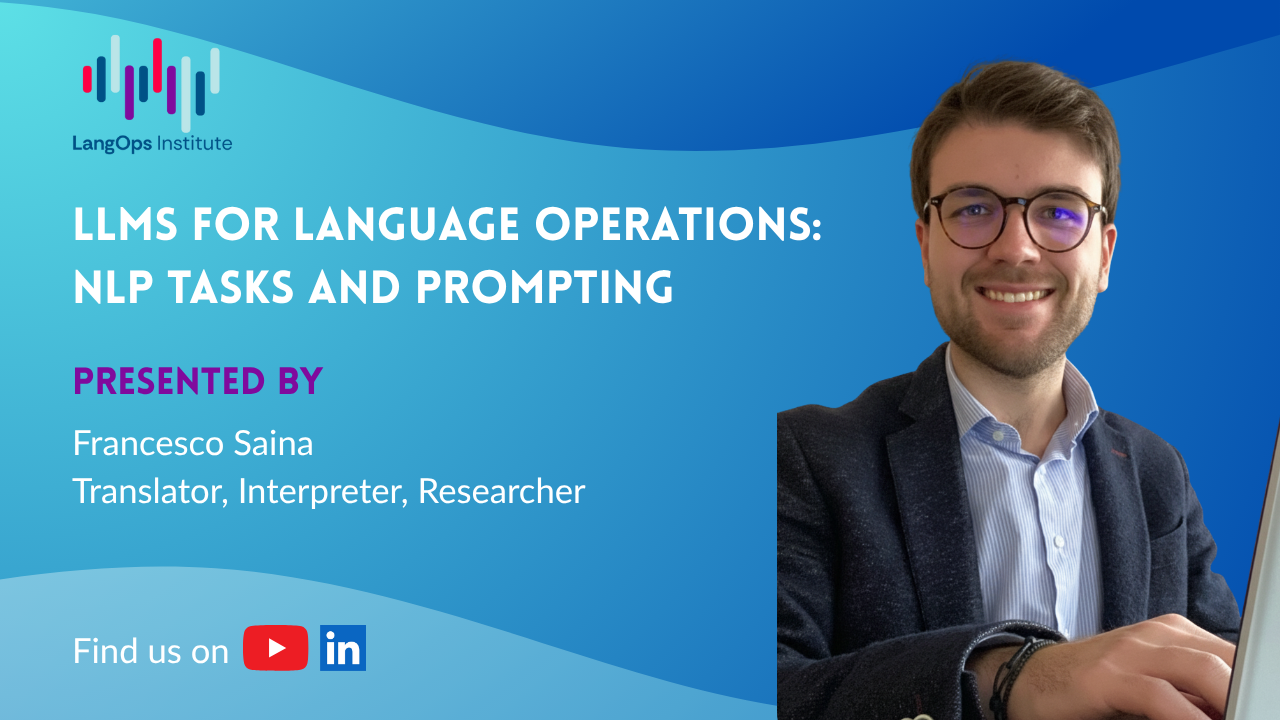
This practical online session is designed for language professionals who want to understand how large language models can be applied to real-world language operations. Through clear explanations and hands-on demonstrations, you will learn how LLMs can support translation, revision, terminology management, and quality assurance workflows using effective prompting and reference materials. The course also addresses key limitations of LLMs and shows how to use them responsibly to improve quality, consistency, and process innovation in language service


This practical online session is designed for language professionals who want to understand how large language models can be applied to real-world language operations. Through clear explanations and hands-on demonstrations, you will learn how LLMs can support translation, revision, terminology management, and quality assurance workflows using effective prompting and reference materials. The course also addresses key limitations of LLMs and shows how to use them responsibly to improve quality, consistency, and process innovation in language service
This practical online course introduces language professionals to the use of large language models (LLMs) in language operations workflows. Through a combination of conceptual explanations and live demonstrations, the session explains how LLMs work at a high level and shows how they can be applied to a wide range of traditional and advanced language tasks using effective prompting.Participants are guided through hands-on examples covering translation, revision, proofreading, terminology management, style guide enforcement, and quality assurance. The course demonstrates how to ground LLM output in reference materials such as glossaries, translation memories, and style guides using retrieval-augmented generation (RAG), and how to manage workflows using projects and task-specific AI assistants. Throughout the session, limitations and risks of LLMs—including semantic ambiguity, bias, non-determinism, and quality variability—are clearly addressed, with practical guidance on how to mitigate them in real-world language operations contexts
.png)

Francesco Saina is a multifaceted Italian linguist working as a translator and interpreter with English, French, and Spanish.
He is also a university lecturer in translation, interpreting, and language technology, and collaborates on academic and industrial research projects on translation and interpreting technology and natural language processing.
His works on the applications of digital technology to the language professions have been published in academic volumes and presented at international conferences.